

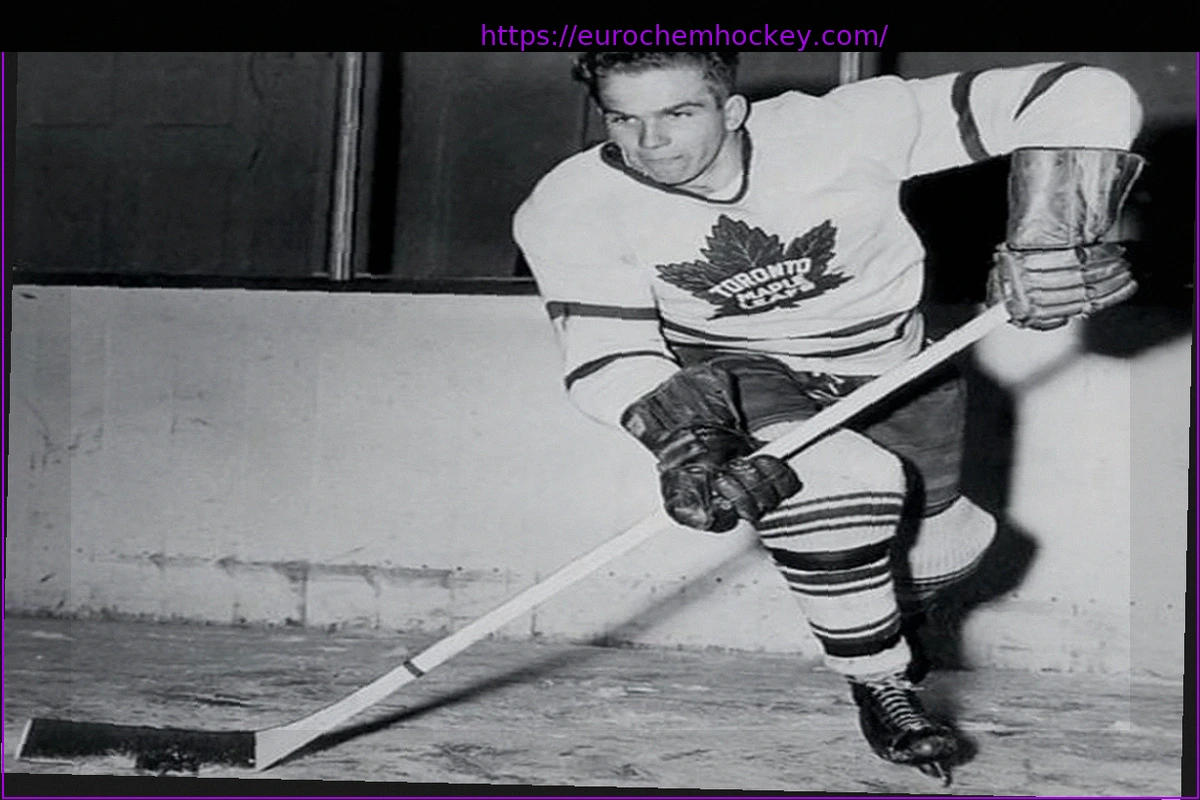
On April 21, 1951, a pivotal moment unfolded in Game 5 of the Stanley Cup Final between the fierce rivals, the Toronto Maple Leafs and the Montreal Canadiens. The game had extended into overtime when Maple Leafs defenseman Bill Barilko propelled himself down the ice, executing a daring headfirst dive towards the Canadiens’ net. In a fluid motion, he released a backhand shot aimed at goalie Gerry McNeil.
McNeil, caught off guard, couldn’t stop Barilko’s shot, which found the back of the net, clinching the 1951 Stanley Cup for the Maple Leafs. The 14,577 spectators at the game witnessed an indelible moment, with many subsequently dubbing it the most iconic goal in the team’s history. Teammates hoisted Barilko in celebration as jubilant fans poured onto the ice. This marked his fourth Stanley Cup win in just five seasons with the club – a triumph that would, tragically, be his last.
Just months later, during a hunting and fishing expedition in northern Ontario, Barilko’s plane vanished into the dense wilderness. It wasn’t until eleven years afterward that the wreckage, along with two sets of human remains, was found partially submerged in a swampy area.
Bill Barilko’s Path to the Maple Leafs
In July 1945, the Maple Leafs received a letter from scout Ernie Orlando, who had discovered two promising brothers, Bill and Alex Barilko, playing for the Porcupine Combines, a junior team in northern Ontario. Orlando described both as ‘husky lads’ and encouraged them to join the Maple Leafs organization, which they did. While Alex never reached the NHL, playing senior-level hockey and later becoming an AHL referee, Bill, nicknamed ‘Bashin’ Bill’ for his bold on-ice presence and adventurous spirit, became a vital defenseman for the Maple Leafs from 1946 to 1951. Although not a prolific scorer, tallying only 62 points in five seasons, many of his slap shot goals were memorable for being scored at critical junctures.
Given the modest NHL salaries of the era, Bill supplemented his income by operating a small appliance store in Toronto during the off-season, dedicating his summers to his beloved pastimes: hunting and fishing. His final contract with the team was for $9,000, with potential bonuses of $500 for making the second NHL All-Star team or $1,000 for the first, neither of which he achieved.
The Mysterious Disappearance of Barilko’s Flight
Tragically, just four months after scoring his iconic Stanley Cup-winning goal, Bill Barilko disappeared without a trace. In August 1951, while visiting his family in Timmins, he received a spontaneous invitation from his friend, local dentist Henry Hudson, to fly to Rupert House on James Bay in northern Quebec for a fishing trip – Barilko’s first of its kind. His mother, Fay, expressed profound apprehension when she learned the trip was scheduled for Friday, August 24th, imploring him not to venture ‘into that wild bush country.’ She later recounted a strong premonition of misfortune.
Her concern stemmed from the fact that Barilko’s father had passed away on a Friday five years prior, making her wary of her son undertaking any risky endeavor on that day. She reportedly told him, ‘I would rather die than see him take this trip.’ Despite her heartfelt pleas, the young Barilko dismissed her worries, leaving his mother so distressed that she refused to bid him farewell with a kiss. The two companions were last observed refueling their aircraft at Rupert House late Sunday afternoon before their inexplicable disappearance.
Canada’s Costliest Air Search
When Barilko and Hudson failed to return, the Royal Canadian Air Force swiftly launched a massive search operation, deploying dozens of aircraft and over 150 personnel. Initially, pilots familiar with the northern territories were not overly concerned, as Hudson was an accomplished flyer with extensive experience navigating the James Bay region for hunting and fishing trips. He possessed a thorough understanding of the wilderness. Nevertheless, the search persisted for two arduous months, meticulously covering an expansive area exceeding 78,000 square kilometers at an altitude of 500 feet. As the rescue mission’s leader aptly described, it was akin to ‘practically looking under every twig.’
With no trace of the missing plane after more than sixty days, the search was finally suspended. The operation’s total expenditure amounted to $385,000, equivalent to approximately $3.7 million in current currency, making it the most expensive air rescue effort in Canadian military history.
It was not until 1962, eleven years later, that Barilko’s plane was finally discovered, remarkably, only 75 miles from his hometown. A helicopter pilot spotted a glint of metal amidst a dense stand of black spruce trees. On June 6th, ground searchers laboriously cut their way through two kilometers of thick bush to reach the crash site. Inside the wreckage, alongside the two human skeletons, were the remnants of fish they had caught, preserved within a damaged pontoon. Evidence at the scene indicated that both of the plane’s wings had been shorn off during the impact. The skeletons remained secured in their seatbelts, suggesting that both men perished instantly upon collision. Bill Barilko was merely 24 years old at the time of his death.

The Enduring Legacy of Barilko’s Stanley Cup Goal
In 1960, the Barilko family erected a tombstone in Timmins, Ontario, featuring images of Bill in his Maple Leafs uniform. His iconic 1951 Stanley Cup-winning goal has cemented its place as one of the most significant and unforgettable moments in the team’s storied past. In 2002, a major publication recognized it as one of the top 10 sporting events fans would never forget.
In 1993, the renowned Canadian rock band The Tragically Hip released ‘Fifty Mission Cap’ as a single from their album Fully Completely. This poignant song served as a direct tribute to Barilko, reintroducing his compelling narrative to new generations of Canadians who might have been unfamiliar with his story, and it became one of the band’s most cherished hits. Bill Barilko’s memory is profoundly revered by both Maple Leafs supporters and the organization itself. Until 2016, only two players in the team’s history had their jersey numbers officially retired: Ace Bailey, who played from 1926 to 1933, and Bill Barilko, whose brief but impactful career spanned from 1946 to 1951.