

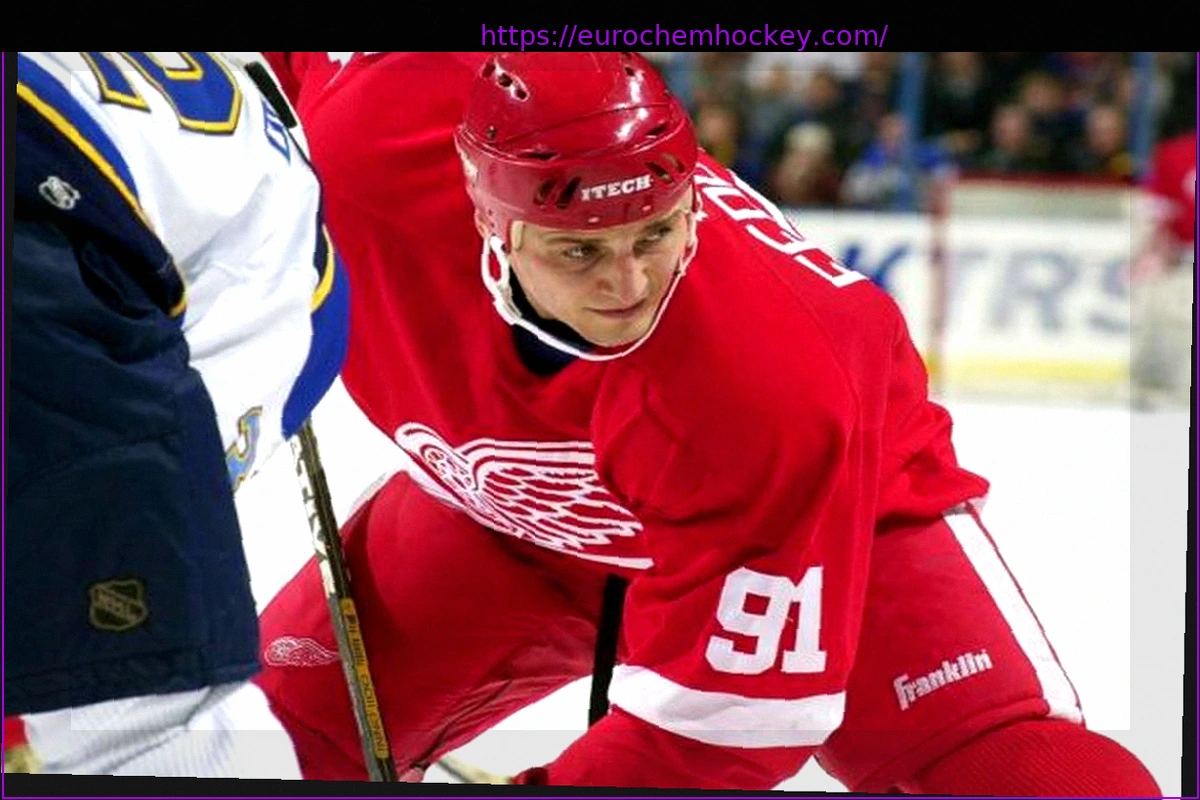
When the Detroit Red Wings announced the retirement of Sergei Fedorov’s No. 91, a flood of memories resurfaced for fans in Hockeytown.
Fedorov’s memorable five-goal performance against Washington, his crucial contributions during Stanley Cup runs, and a career filled with highlight-reel plays all came to mind. This long-awaited recognition finally grants him a permanent place in the Red Wings’ esteemed history.
The delay in this recognition is the subject of our discussion today. After a significant holdout during the 1997-98 season, which compelled the Red Wings to match a lucrative offer sheet from the Carolina Hurricanes, Fedorov ultimately chose to sign with the Anaheim (then Mighty) Ducks following the 2002-03 season.
This decision was a profound disappointment for the franchise. Not only did Fedorov depart, but it was widely reported that he accepted a smaller contract with Anaheim than what Detroit had initially offered.
The fanbase, the organization, and especially the Red Wings’ ownership, the Ilitch family, felt the sting of his departure. Fedorov’s exit left a wound that took over two decades to begin healing.
But what if Fedorov had remained? Undoubtedly, his number would have been retired much sooner. Yet, what would have been the impact on the team itself? Would the Red Wings have maintained their successful trajectory with Fedorov still on the roster? I believe the outcome might have been quite different. Here’s an exploration of why.
The 2003-04 Red Wings with Fedorov
Let’s begin with the established facts: Fedorov signed with Anaheim on July 19, 2003. Just days later, Detroit acquired Ray Whitney.
Had Fedorov accepted Detroit’s five-year, $50 million proposal, it’s improbable that the team would have then signed Whitney. Assuming all other offseason moves by the Red Wings remained constant, here’s how their lineup might have appeared for the 2003-04 season:
| LW | C | RW |
|---|---|---|
| Brendan Shanahan | Sergei Fedorov | Tomas Holmstrom |
| Henrik Zetterberg | Pavel Datsyuk | Brett Hull |
| Steve Thomas | Kris Draper | Steve Yzerman |
| Kirk Maltby | Mark Mowers | Darren McCarty |
| Boyd Devereaux | Jason Williams |
| LD | RD | G |
|---|---|---|
| Nicklas Lidstrom | Mathieu Schneider | Manny Legace |
| Jiri Fischer | Chris Chelios | Curtis Joseph |
| Jason Woolley | Mathieu Dandenault | Dominik Hasek |
| Derian Hatcher (Inj.) | Jamie Rivers |
Key Considerations & Hypotheticals
- Pavel Datsyuk’s emergence occurred after Fedorov’s departure; would his development have followed the same trajectory if Fedorov had stayed?
- To fill Fedorov’s void, Detroit acquired Robert Lang, the league’s leading scorer at the time, at the trade deadline. This move would likely have been unnecessary with Fedorov still on the team.
- Instead, General Manager Ken Holland might have prioritized a top-tier defenseman (such as Brian Leetch or Sergei Gonchar) or a mid-tier forward akin to Whitney (like Valeri Bure, Anson Carter, or Geoff Sanderson).
- The package traded for Lang—Tomas Fleischmann, a first-round pick (which became Mike Green), and a fourth-rounder—would probably have been required for Leetch or Gonchar, while a forward would demand less. It’s entirely possible Fleischmann would have remained, and Detroit could have retained its first-round pick, potentially still selecting Green.
- Detroit secured the President’s Trophy in 2003-04 without Fedorov; with him, they would likely have been an even stronger team.
- Lang was Detroit’s most consistent performer in the playoffs. It’s reasonable to assume Fedorov would have exceeded Lang’s nine points in 12 playoff games.
- Could Detroit have overcome the Calgary Flames in the second round? Possibly. They might have also defeated the San Jose Sharks in the Conference Final, setting up a clash with the Tampa Bay Lightning for the 2004 Stanley Cup.
- If Detroit reached the Conference Final or went further, would Dave Lewis have remained the Red Wings’ coach leading into and beyond the lockout?
- Furthermore, would Mike Babcock’s coaching reputation have suffered without Fedorov on his Anaheim team?
The Lockout and the 2005-06 Red Wings
The 2004-05 lockout was an unavoidable event, unaffected by Fedorov’s presence or absence. However, his decision would have significantly influenced the team’s composition post-lockout.
A key provision of the new collective bargaining agreement (CBA) was a 24 percent reduction in player salaries to conform to the new $39 million salary cap. Under these terms, Fedorov’s hypothetical five-year, $50 million contract from 2003 would have translated into a $7.6 million salary/cap hit through the 2007-08 season.
The new CBA also introduced compliance buyouts, enabling teams to terminate player contracts without salary cap implications. In 2005, Detroit utilized this to buy out Whitney, Darren McCarty, and Derian Hatcher. Following these buyouts, Detroit’s 23-man roster had a total cap hit of $38,247,500, leaving a mere $752,500 in cap space.
Returning to our alternate reality where Fedorov remained in Detroit, the Red Wings would have needed more substantial salary cap adjustments to become compliant. Replacing Lang with Fedorov would have put the team $3,047,500 over the cap, not even accounting for any other players acquired during the 2003-04 season.
Two primary strategies for achieving cap compliance emerge here. The first is a gradual, piecemeal approach:
- Re-signing players like Mathieu Schneider ($3.3 million), Steve Yzerman ($1.25 million), Chris Chelios ($850,000), and/or Jason Woolley ($507,000) for less money, or letting them go.
- Signing less expensive free agents than Chris Osgood ($900,000), Andreas Lilja ($650,000), and/or Mikael Samuelsson ($537,500).
- Buying out Kirk Maltby ($1.444 million).
Alternatively, Detroit could have opted to buy out Fedorov himself. Having two players—Fedorov and Nicklas Lidstrom, who had an identical $7.6 million cap hit—account for 39 percent of the total salary cap would have been far from ideal. Moreover, Fedorov was 35 at this juncture and would turn 36 in December 2005.
Regardless of the approach, the construction of the 2005-06 Red Wings would have been dramatically different from our historical timeline. This would have led to significant ripple effects for the franchise, potentially derailing their path to another Stanley Cup (e.g., more drastic roster changes before 2006-07 with Yzerman and Shanahan’s departures, absence of Osgood for the 2007-08 playoff run, etc.). It’s also important to note that Fedorov’s offensive production declined in the post-lockout NHL. While he played on some less competitive teams, it’s reasonable to assume that seasons with 60 to 80 points were largely a thing of the past for him, regardless of where he played.
Final Thoughts
In a hypothetical world where Fedorov re-signed with the Red Wings in 2003, they might have genuinely contended for the Stanley Cup in 2004. However, the period beyond that becomes much less clear. Innumerable possibilities exist. Based on this analysis, I’m not convinced they would have secured another Cup in the post-lockout NHL.
It’s a compelling subject for speculation. There’s an appealing romantic notion of Fedorov as a lifelong Red Wing, but would altering the past truly be beneficial? Probably not.
It’s doubtful Fedorov himself would have wished for a different outcome. He once stated, “I remember exactly how I felt back then. Of course, there’s a part of my reasoning that I’ve only ever shared with those closest to me. But I can honestly say it was the right decision. It was a deeply human, sincere choice. At that time, it was how I truly felt.”
Regardless of what could have been, it will be a momentous occasion to see Fedorov’s No. 91 elevated to the rafters of Little Caesars Arena in January.