

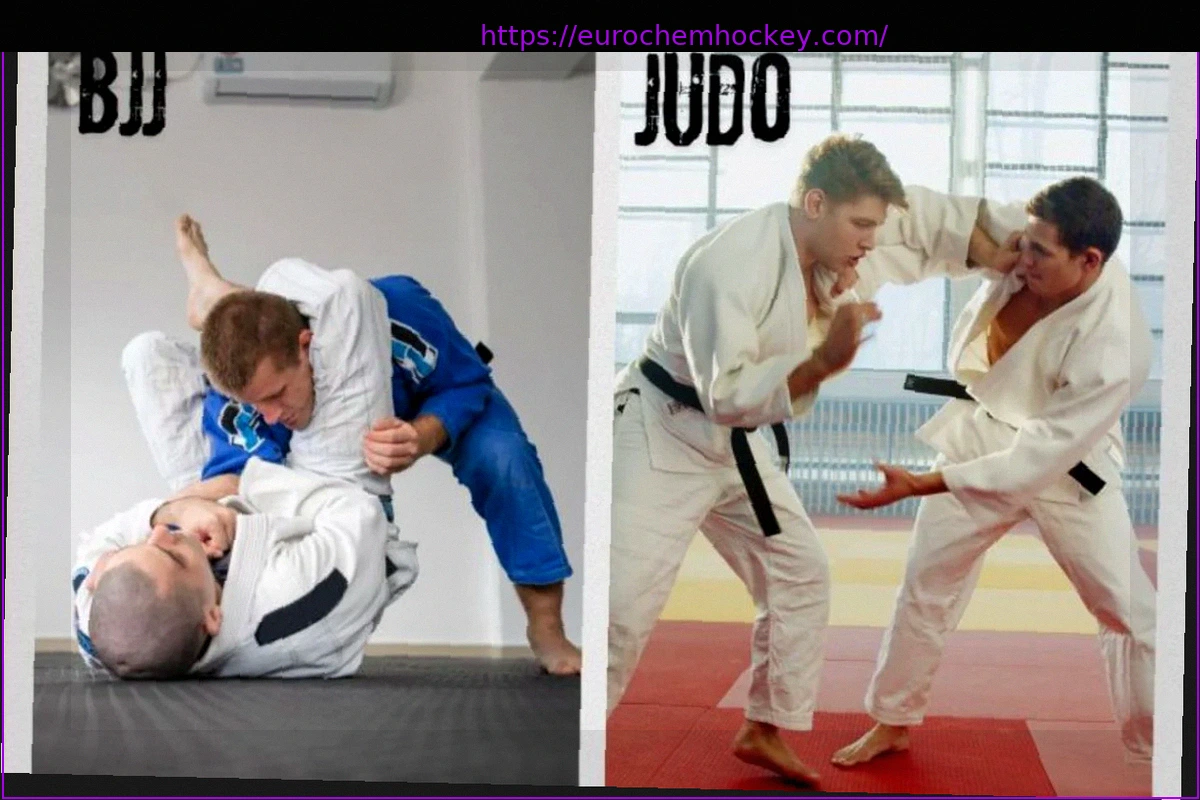
While Judo and Jiu-Jitsu share common origins, wear similar uniforms, and compete on the mat, they are distinct disciplines with differing philosophies, rules, and strategies for victory.
What is Judo?
Judo, at its core, is a martial art focused on bringing an opponent to the ground with force and control. A decisive throw, known as an ‘Ippon,’ immediately ends the match, leaving no room for second chances.
Founded by Jigoro Kano in Japan in 1882, Judo evolved from traditional Jujutsu into a structured sport. It became an Olympic sport in 1964 and is now governed by the International Judo Federation, with over 200 member countries.
Judo’s Scoring System:
- Ippon: An instant win achieved through a throw, a 20-second pin, or a submission.
- Waza-ari: A half-point awarded for a less decisive throw or pin. Two Waza-ari equal an Ippon.
- Shido: A penalty awarded for passivity or rule infringements.
Matches for senior male athletes typically last 4 minutes. In case of a tie, sudden-death overtime is employed. Recent Judo World Championships, like the one held in Budapest, have showcased the sport’s global competitiveness, with Georgia securing its first Mixed Team World title. The evolution of traditional Judo has been significantly influenced by its increasing global participation.
Jiu-Jitsu: A Different Approach to Problem-Solving
Brazilian Jiu-Jitsu (BJJ) has developed as a distinct sport by incorporating elements of ground fighting that are less emphasized in Judo. Its history traces back to Brazil in the early 20th century, with roots in the early 1900s when Judo master Mitsuie Maeda, who trained in Japan’s Kodokan, emigrated and taught Carlos Gracie his skills.
The International Jiu-Jitsu Federation (JJIF) organizes Jiu-Jitsu competitions with a point-based system that reflects a ground-focused philosophy:
Jiu-Jitsu’s Scoring System:
- Takedown: 2 points
- Guard Pass: 3 points
- Mount or Back Control: 4 points
- Submission: An immediate win, similar to Ippon in Judo.
Jiu-Jitsu matches are longer than Judo matches, lasting between 5 to 10 minutes depending on the belt level. The pace is generally slower and more strategic, focusing on positional control and waiting for the opportune moment to attack.
Key Differences Between Judo and Jiu-Jitsu
The fundamental difference lies in where the primary focus of the fight takes place. Judo emphasizes standing techniques and throws. Techniques like Uchi Mata, Seoi Nage, and Harai Goshi are highly technical and aim to disrupt an opponent’s balance for a decisive throw.
If a Judo match goes to the ground, the rules encourage quick resolutions. A pin must be held for about 10-15 seconds to be scored. Extended grappling exchanges on the ground are discouraged, with referees penalizing prolonged inactivity. This actively discourages lengthy ground battles.
Jiu-Jitsu, conversely, thrives on the ground. A practitioner on their back, controlling an opponent with their legs (in guard), is considered to be in a dominant or at least an active position. From here, skilled practitioners execute various submission holds like triangle chokes, armbars, and kimuras. The ground game is paramount in Jiu-Jitsu.
This distinction explains why many mixed martial arts practitioners train in both disciplines: Judo excels at initiating the fight and taking it to the ground, while Jiu-Jitsu specializes in what happens once you are there.
President’s Cup: An Inclusive Competition
The U.S. President’s Cup in Judo is a significant national tournament. The 2025 edition, held over 23 days in November in Irving, served as a qualifying event for various divisions, including Senior Level C, Junior Level 3, veterans, and athletes with visual impairments.
The President’s Cup is notable for its inclusivity, catering not only to elite senior athletes but also to junior, veteran, and visually impaired competitors. This broad scope is a testament to a healthy development ecosystem within the sport.
The 2026 President’s Cup is scheduled for November 22nd in Irving, providing a final qualification opportunity for athletes before the year’s end, coinciding with the Olympic trials.
Deep Dive into Techniques: Standing vs. Ground Game
The technical disparities between Judo and Jiu-Jitsu require athletes to undergo significant adjustments when transitioning between them. Both disciplines demand precise balance disruption for throws in Judo and positional control in Jiu-Jitsu.
Judo techniques, with their emphasis on biomechanics and efficient movement, translate well into combat sports like MMA. The success of a Judo throw relies heavily on disrupting an opponent’s equilibrium, something brute force alone cannot overcome.
Jiu-Jitsu’s ground hierarchy is structured around established positions. The focus is on securing control before attempting a submission. A typical sequence involves establishing dominant positioning, such as a sweep or a guard pass, before moving towards a submission attempt.
In Jiu-Jitsu, a defensive pass against an experienced practitioner could lead to prolonged technical pressure. In Judo, such a situation would likely result in a stoppage or a penalty for lack of progress.
The Current Landscape of Competition
Judo’s Olympic status provides a structured competitive framework. The Judo World Tour spans five continents, featuring Grand Prix, Masters tournaments, and direct Olympic qualification events. The 2025 season included a World Championship in Paris with a record number of participants and cadet/junior world championships in Bulgaria and Peru, highlighting the sport’s impressive development.
The emergence of no-gi grappling competitions within Jiu-Jitsu has also broadened its appeal, attracting athletes who may not have prior experience with the kimono. This expansion indicates the sport’s growing accessibility and evolution.
Can and Should You Practice Both Disciplines?
Many dedicated athletes do train in both Judo and Jiu-Jitsu, but the transition requires time and effort. Judo practitioners often find the standing phase challenging in Jiu-Jitsu, as the emphasis on being on the ground contradicts their ingrained instincts from Judo.
Conversely, Jiu-Jitsu practitioners may struggle with the explosive standing game of Judo, which requires different grips, footwork, and rapid entry techniques. Many Jiu-Jitsu athletes begin their Judo journey with basic throws and build from there.